Fanucci
The GodfatherFanucci is a feared but ultimately exposed Black Hand extortionist in the early New York life of Vito Corleone. He survives by converting reputation, violence, and theatrical menace into tribute, yet his demand for a share of Vito’s first substantial earnings reveals the weakness beneath that performance. Fanucci’s murder is therefore more than an isolated killing: it is the formative act that removes one local tyrant and opens the path by which Vito builds an alternative system of protection, loyalty, and power.
Identity and Method
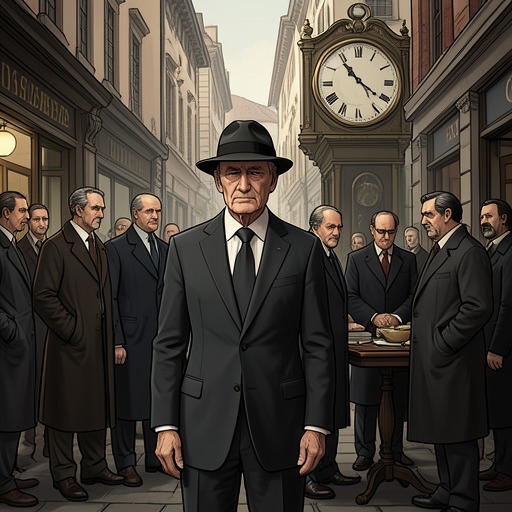
Fanucci lives in the Italian tenement neighborhood where Vito works in the Abbandando grocery store. He is heavy-set and fierce-looking, dresses in expensive light-colored suits, and wears a cream-colored fedora. His reputation identifies him with the Black Hand, an offshoot of the Mafia that extorts money from families and shopkeepers through threats of physical violence. His intimidation works most effectively against elderly couples without sons, while some shopkeepers pay small sums simply for convenience.
Fanucci also preys on criminals. He collects from illegal Italian lottery operations and gambling games conducted in tenement apartments, treating fellow lawbreakers as another source of revenue. The Abbandando grocery pays him a small tribute despite the protests of young Genco Abbandando, whose father forbids him to confront Fanucci. The arrangement shows the limited basis of Fanucci’s authority: he is not an institution with universal reach, but a scavenger who turns fear into a private income.
His appearance reinforces that theatrical authority. After three young men attack him and cut his throat, Fanucci survives with a circular scar extending from ear to ear beneath his chin. He leaves the scar visible, and when he later approaches Vito, his coarse features and heavy black brows are softened by an oddly amiable smile. The contrast between the brutal scar, the immaculate suit, and the apparently cordial manner makes his menace a performance as carefully managed as his demands.
The Demand on Vito Corleone
After Vito Corleone, Peter Clemenza, and Salvatore Tessio rob a silk truck, the three men divide the proceeds. Vito’s decision to give his entire share of the dresses to a fence leaves him with seven hundred dollars, still a considerable sum in 1919. The following day Fanucci stops him in the street and claims that people have told him Vito is rich. He says Vito and his companions have treated him badly and insists that, because the neighborhood is his, Vito must let him “wet my beak.” The phrase names the Mafia practice of taking part of another man’s profit; Fanucci is demanding the share of the loot he believes his position entitles him to receive.
Vito does not answer immediately. His silence is not confusion but calculation. He knows that Fanucci’s power comes from his own physical brutality, perhaps supplemented by gunmen hired for particular jobs, rather than from a secure network capable of punishing every refusal. Vito also knows of a gambling operation that has never paid Fanucci and has suffered no consequences. These observations transform the encounter from a simple extortion attempt into a judgment on whether Fanucci is genuinely powerful or merely protected by the assumption that he is.
Vito proposes to Clemenza and Tessio that each give him two hundred dollars so that he can settle Fanucci’s demand. He tells them to let Fanucci ask for the money, to avoid bargaining or quarrelling, and to make clear that they are willing to pay. Vito will then negotiate with Fanucci himself. The plan presents him as a mediator, but it also separates the other two men from the decisive risk and allows Vito to control both the money and the meeting.
Murder and the Idea of Destiny
Vito ultimately decides that Fanucci must die. Fanucci wants seven hundred dollars from him by force, while Vito calculates that killing him will preserve the seven hundred dollars: the three hundred he would otherwise pay himself, plus the two hundred contributed by each of his companions. Vito’s reasoning is coldly practical. He has no personal debt to Fanucci, no family bond with him, and no affection that might justify paying to keep him alive. Fanucci, in Vito’s judgment, is not worth seven hundred dollars.
The decision also becomes the foundation of Vito’s repeated belief that every man has only one destiny. He imagines an alternative life in which he pays the tribute, remains a grocery clerk, and perhaps eventually owns a grocery store. Instead, the circumstances have brought Fanucci to him as the force that will set him on the path to becoming a Don. The narration presents this as both fate and self-recognition: destiny supplies the encounter, but Vito’s intelligence, courage, and willingness to act determine what the encounter means.
The danger is real. Fanucci may possess powerful friends; the police may catch Vito; the electric chair remains a possible consequence. Yet Vito has lived under a sentence of death since the murder of his father in Sicily. At twelve, he escaped men who intended to kill him and crossed the ocean under a strange name. Years of quiet observation have convinced him that he possesses more intelligence and courage than the men around him, although he has never had the opportunity to use them. Fanucci’s demand provides that opportunity.
Before the meeting, Vito sends his wife away with their two children, Santino Corleone and Fredo Corleone. She is to remain at the tenement entrance and keep the children outside until he gives permission for them to return. Her fear shifts from Fanucci to her husband, because Vito is visibly changing from a quiet, gentle, apparently harmless nobody into a man radiating dangerous force. His protective persona is falling away, and the murder becomes the first public consequence of the power that had previously remained concealed.
Vito waits in the darkened vestibule of Fanucci’s apartment house near the warehouses and railroad freight yards west of Eleventh Avenue. He carries a gun he has never fired, though childhood hunting in Sicily taught him to handle the lupara. When Fanucci crosses the street, recognizable as a white figure beneath the light, Vito lets him enter through the door and fires. The first shot leaves Fanucci struggling to remain upright and reaching toward his own weapon. Vito fires a second bullet into the red mark on Fanucci’s white shirt, then presses the gun to Fanucci’s cheek and fires into his brain. The entire killing takes no more than five seconds.
Consequences and Narrative Significance
Fanucci’s death removes the neighborhood’s existing collector and permits Vito to redirect the money, loyalty, and protection that had been organized around fear. Vito soon prospers, gains contacts and experience, protects Italian families running small speakeasies, and begins accumulating good deeds as deliberately as a banker accumulates securities. His later organization gives Peter Clemenza and Salvatore Tessio the rank of caporegime, places Genco Abbandando in the role of Consigliere, and inserts layers between Vito and operational acts. The contrast is decisive: Fanucci rules through direct intimidation, whereas Vito turns violence into a structured system of obligations and delegated authority.
Vito’s later “Godfather” system of favors depends on the principle that protection creates debt and friendship creates a claim that may be redeemed by service. Fanucci’s crude tribute-taking anticipates that logic in distorted form, but Fanucci offers neither dependable justice nor enduring reciprocity. Vito’s authority grows because he promises to solve troubles rather than merely threaten victims. The later account of Don Corleone as a man to whom everyone comes for help, and who does not abandon a supplicant once friendship has been proclaimed, stands against Fanucci’s narrower economy of fear.
Fanucci therefore remains important even after his death. His cream-colored hat and scar become the visual memory of a failed order, while his attempted collection marks the moment when Vito chooses to become the kind of power capable of replacing it. Later scenes involving surveillance, police records, family chains of command, and succession continue to echo the question Fanucci first poses: who truly controls the neighborhood, and what makes obedience seem inevitable? By the time Michael Corleone becomes the most powerful Family chief in the United States and the Corleone Family closes its New York operation, Fanucci’s local tyranny has been absorbed into a far larger and more disciplined structure. His death is the small, brutal origin point of that transformation.